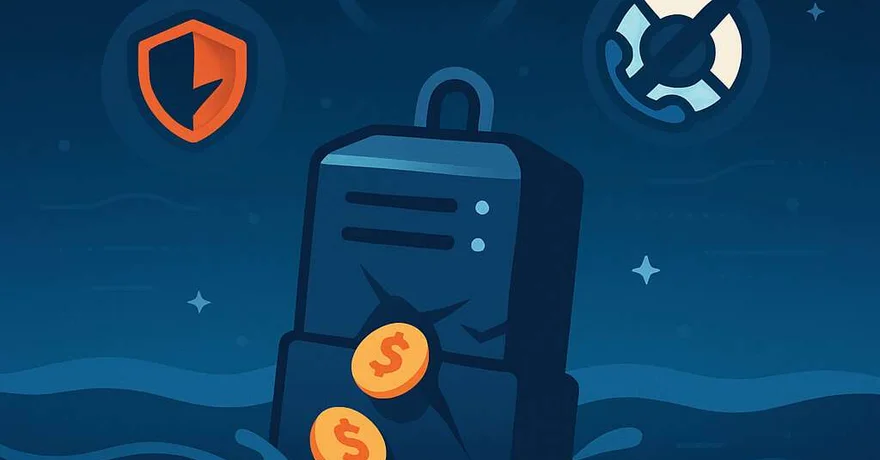
At first glance, cheap web hosting seems like a no-brainer. A few dollars a month, a flashy offer banner, maybe even a free domain tossed in for good measure. For many small businesses, it feels like a smart budget decision—until the hidden costs start surfacing.
When it comes to hosting, the sticker price rarely reflects the total cost of ownership. Beneath the surface, budget hosting plans often come with trade-offs in security, performance, support, and long-term pricing. These trade-offs don’t just affect your website—they impact your revenue, reputation, and ability to grow.
At HarborByte, we’ve helped countless SMBs migrate off underperforming bargain hosts and onto platforms that are stable, secure, and strategically scalable. Here’s what every business owner should know before anchoring to a $2.99/month plan.
1. Security: The Breach You Didn’t Bargain For
Recent high-profile hosting breaches have shown how long attackers can lurk inside shared environments, injecting malware and compromising customer data. While that may sound like an isolated headline, it’s actually a common risk for sites on low-cost, shared hosting plans.
Most budget hosts pile dozens—sometimes hundreds—of customer sites onto a single server with minimal isolation. If your digital neighbor installs a compromised plugin or fails to update their WordPress install, it could expose your site to cascading threats.
To make matters worse, cheap hosts often cut corners on foundational security features:
-
SSL Certificates that should be free (e.g., via Let’s Encrypt) are marked up or excluded (some charge $60–90/year)
-
Malware scans are often only triggered after an incident
-
Firewall rules are outdated or non-existent
Security reporting consistently shows that a large share of compromised websites are running outdated CMS software or vulnerable extensions, both of which are common on hosting plans with no auto-update support or proactive patching.
HarborByte’s Approach: We isolate sites, monitor real-time threats, apply security patches within 48 hours of release, and include SSL by default—no upsells, no surprises.
2. Performance: When Speed Sinks Sales
Your hosting directly affects page speed—and in turn, conversion rates. Research from Google and Portent shows that:
-
Bounce rate increases by 32% as load time rises from 1 to 3 seconds
-
Pages taking over 5 seconds can see 90%+ bounce rates
-
A 0.1 second speed improvement can boost conversions by up to 8%
Cheap hosting plans are often subject to the “noisy neighbor” effect. That’s when one site hogs CPU or RAM resources, slowing down everyone else on the same shared server. Even if your own code is clean and optimized, your site can be dragged down by others.
You’ll also find:
-
No built-in caching or CDN support
-
Low thresholds for traffic spikes (throttling starts fast)
-
Inconsistent uptime during peak hours
Over time, the performance impact compounds. You lose search ranking, frustrate users, and miss out on sales—all to save a few bucks a month.
HarborByte’s Approach: We use managed hosting stacks with built-in CDN, advanced caching, and performance tuning. Every client benefits from Core Web Vitals optimization and quarterly site performance reviews.
3. Support & Uptime: The Hidden Price of Downtime
You’ll notice something suspiciously absent in many budget hosting plans: a service level agreement (SLA). Without an SLA, there’s no guaranteed uptime—just a vague promise to “do our best.” And when something breaks?
The real costs of cheap support show up in:
-
2–12 hour ticket response times (based on community benchmarks)
-
Language barriers or outsourced support teams with limited authority
-
Long queues during outages or platform-wide bugs
More critically, downtime is expensive. ITIC and DivergeIT estimate that the average cost of website downtime for SMBs ranges from $427 per minute to $25,000–100,000+ per hour. Even a single half-hour outage every quarter can erase any hosting “savings.”
HarborByte’s Approach: We offer a 99.95% uptime SLA, responsive human support with sub-15-minute response goals, and 24/7 monitoring. Problems are solved before they hit your inbox.
4. Renewal Shocks & Feature Upsells
Cheap hosting often isn’t cheap for long. Many budget providers advertise super-low introductory rates, then increase your renewal by 50–70% after the first year. For example, Bluehost’s shared hosting plan jumps from $2.95 to $10.99/month after year one.
Worse still, basic features are often missing:
-
No daily backups (or they cost extra)
-
No staging environment for testing
-
SSL, domain privacy, and even email often cost more
If you want true feature parity with a mid-tier managed host, you’ll end up spending far more than the advertised plan rate—and still get second-tier support.
HarborByte’s Approach: We offer transparent, flat-rate pricing. Daily backups, SSL, staging sites, and full security suites are all standard. No bait-and-switch.
5. The True Cost of Cheap Hosting: A Simple Calculator
Let’s break it down with a real-world comparison.
Scenario: Bargain Host Plan
-
Intro price: $60/year
-
Renewal: $180/year
-
Downtime: Two 30-minute outages/quarter = 4 hours/year = $25,620+ lost (based on $427/minute)
-
Speed loss: Slower pages convert up to 2.5x worse, per Portent
Total Annual “Cost”: ~$25,800+
That’s a huge hit for a small business to take—all because of what’s hidden beneath the surface of “cheap.”
6. What to Ask Before You Anchor Your Site
Before you commit to any web host, ask these questions:
-
What’s your real renewal rate after year one?
-
Is SSL included—or an upsell?
-
Do you offer daily backups and restore support?
-
How do you handle traffic spikes and throttling?
-
Is there a staging environment for dev/testing?
-
Do you offer an uptime SLA with compensation?
If the answer to most of these is “no” or “extra,” steer clear.
7. HarborByte: A Hosting Lighthouse in the Storm
We built our managed hosting platform with growing SMBs in mind. You shouldn’t need to become a sysadmin just to keep your website online, fast, and secure.
With HarborByte Managed Hosting, you get:
-
World-class hosting on Google Cloud, AWS, DigitalOcean, and other high-quality providers
-
Fully managed infrastructure with proactive updates
-
Enterprise-grade security baked in
-
Lightning-fast page speeds and Core Web Vitals optimization with complimentary CDN included
-
Transparent pricing with no surprise renewals
-
Real support, from real humans—not bots or outsourced scripts
We handle your tech so you can focus on your business. No more surprise outages. No more performance mysteries. Just reliable digital infrastructure, built for scale.
Ready to Jump Ship?
If your hosting plan is holding your website back—or putting your revenue at risk—it’s time to make a change. Let us benchmark your current host and show you what you’re really paying for.
Book a free HarborByte Hosting Audit today and discover the smarter way to stay online.